
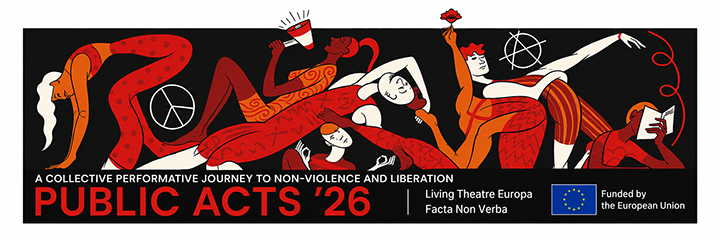
Public Acts: A Journey to Non-Violence
A 10-Day Residential Theatre Laboratory in Rocchetta Ligure
23 July – 1 August
Public Acts: A Journey to Non-Violence is an Erasmus+ collaboration between Living Theatre Europa in Italy and Facta Non Verba in Greece. The project invites young people aged 18–35 to take part in a 10-day residential theatre laboratory in the hills of Rocchetta Ligure, in the province of Alessandria — a place deeply connected to the history of The Living Theatre and formerly one of its European homes.
This is an Erasmus+ project. The workshop is free for selected participants as part of the Erasmus+ project. Participation is limited and selection will be based carefully on the motivation letter and answers submitted through the application form: GOOGLE FORM.
In line with the Erasmus+ objectives of inclusion and diversity, Public Acts is aimed especially at young people from marginalized and underrepresented backgrounds. In this project, however, marginalization does not refer only to already-defined social categories, but to a broader human and social condition: living in peripheral or abandoned areas, feeling excluded from cultural life, carrying the weight of burnout, gender-based violence, economic fragility, loneliness, or the silent feeling of being outside the centers where decisions are made.
Without erasing the specific forms of exclusion, we begin from the idea that many of us experience marginalization in different ways — and that theatre can become a space where these experiences are named, shared, transformed, and brought into public action.
Inspired by The Living Theatre’s cycle The Legacy of Cain, the project investigates six “houses” of power — War, Death, Private Property, Money, the State, and Love distorted by power — transforming difficult questions into embodied practice, shared performance, and civic encounter.
The laboratory brings together facilitators from both Living Theatre Europa and Facta Non Verba, creating a dialogue between different traditions of collective creation, political theatre, participatory dramaturgy, embodied research, and contemporary performance practices.
The project is inspired by The Living Theatre, founded in New York in 1947 by Judith Malina and Julian Beck. The Living Theatre became one of the most radical and influential theatre companies of the twentieth century, known for breaking the wall between actors and audience, bringing theatre into the streets, and transforming performance into a living practice of freedom, nonviolence, collective creation, and social change.
From works such as The Connection, The Brig, Mysteries and Smaller Pieces, Frankenstein, Antigone, and Paradise Now, The Living Theatre developed a theatre of presence, ritual, political confrontation, and public participation. In the 1970s, after the company’s imprisonment in Brazil under the military dictatorship, The Living Theatre began a long cycle of work called The Legacy of Cain, asking a simple and terrible question: why are human beings violent?
From that question emerged works such as Seven Meditations on Political Sadomasochism, The Money Tower, and Six Public Acts. These works moved theatre out of the closed stage and into civic space: streets, squares, banks, courthouses, churches, police stations, monuments, and public assemblies. Theatre became not only something to watch, but something to do together.
Living Theatre Europa continues this lineage today through workshops, public actions, collective creation, revivals of historic Living Theatre works, and new performances rooted in the same anarchist-pacifist, anti-authoritarian tradition. Directed by Gary Brackett, a member of The Living Theatre since 1987, Living Theatre Europa carries forward the company’s work through training, street theatre, ritual, political performance, non-fictional acting, and the development of new public acts for the present moment.
At the heart of Public Acts are six themes, which we call “houses”: War, Death, Private Property, Money, the State, and Love distorted by power. These houses come from The Living Theatre’s research into the master/slave system: the visible and invisible ways domination lives in society, in institutions, in relationships, and inside our own bodies.
These houses are not abstract ideas. They touch daily life. They appear in war and borders, in rent and debt, in police and documents, in work and exhaustion, in possession and jealousy, in silence and fear, in the ways we obey, submit, resist, desire, consume, love, and wound one another.
Through theatre, movement, voice, ritual, improvisation, public action, and collective creation, we will ask how domination is learned — and how it can be unlearned. How does power move through us? Where do we obey? Where do we resist? Where does love become possession? Where does fear become violence? Where can we begin again?
The Work of The Living Theatre
The laboratory will work with the material, scenes, forms, and expressive languages that make up the living alphabet of The Living Theatre.
The techniques may include:
Non-fictional acting
Collective creation
Artaudian expression
Ritual and ceremony
Biomechanics
Yoga and mindfulness practices
Elements of Brechtian and Piscatorian political theatre
Street theatre
Vocal and physical chorus work
Public assembly
Direct encounter with the audience
These are not museum techniques. We do not approach the historic works of The Living Theatre as dead forms to be repeated archaeologically. We enter them as living containers: structures capable of being filled again by new bodies, new voices, new questions, new conflicts, new fears, new desires, and new public urgencies.
A form becomes alive when a group passes through it together.
The workshop will therefore include both work with historical Living Theatre material and the creation of new material by the participants. We will study, embody, transform, and re-contextualize forms from The Living Theatre tradition while asking what these forms can mean now, in our own cities, our own bodies, our own political moment.
The laboratory will be integrated with audio-video materials on the formal, aesthetic, and political history of The Living Theatre.
Facta Non Verba’s Contribution
Facta Non Verba is a theatre collective based in Thessaloniki, Greece, with twenty-four years of continuous artistic, educational, and socio-political activity. Working at the intersection of political theatre, collective creation, participatory dramaturgy, practice-based artistic research, and community engagement, the group has developed a distinctive methodology rooted in dialogue, plurality, embodied practice, and non-authoritarian pedagogical approaches.
Its work explores how theatre can function as a space of encounter, civic participation, collective reflection, and social transformation while respecting the autonomy, diversity, and lived experience of participants.
Within Public Acts, Facta Non Verba contributes methodologies developed through its long-term artistic and research practice, including the Polarities methodology and the metaphor of the mycelial network, developed by Elena Stamatopoulou (Aristotle University of Thessaloniki) through her work in political theatre, participatory performance, collective creation, and practice-based artistic research.
These approaches explore how tension, difference, vulnerability, contradiction, and interconnection can become creative resources for collective creation, public engagement, and socio-political reflection.
Through movement, voice, improvisation, relational dramaturgy, socio-political reflection, and participatory composition, participants will collaboratively create performative material that emphasizes collective agency, emotional intelligence, critical awareness, and democratic participation.
Rather than seeking consensus through uniformity, Facta Non Verba's practice investigates how diverse perspectives, experiences, and positions can coexist within shared artistic processes, generating temporary communities of dialogue and action.
The Facta Non Verba module will be facilitated by Elena Stamatopoulou, theatre practitioner, researcher, university lecturer, and founding member of Facta Non Verba, whose work focuses on political theatre, collective creation, dialogical pedagogy, participatory dramaturgy, and practice-based artistic research.
More information: https://factanonverba.gr
Collective Creation
Collective creation does not simply mean that everyone invents new scenes from zero. It means creating a field where the group becomes a living organism of attention, energy, responsibility, risk, and imagination.
In The Living Theatre tradition, collective creation is the practice through which performers, participants, and facilitators transform urgent questions into shared theatrical form. It is made of improvisation, conflict, listening, repetition, physical exploration, public risk, and the slow emergence of a common rhythm.
Sometimes collective creation produces entirely new scenes. Sometimes it transforms existing forms by passing them through the bodies and voices of a new ensemble. Sometimes it happens through a public encounter, when the audience, the street, the city, and the performers alter the work in real time.
The collectivity is not only in the authorship of new material. It is also in the way the group fills the container with life.
Participants will therefore create original performative material inspired by the six houses of The Legacy of Cain. They will work individually and in groups to transform questions, memories, images, gestures, sounds, conflicts, and social concerns into theatrical action.
Living Theatre Europa together with Facta Non Verba team will support the participants in shaping the material and guiding the final phase of staging, so that the work can move from workshop exploration into public performance.
The goal is not a polished theatrical product in the conventional sense. The goal is a living public act: a performance/action that meets people directly, interrupts ordinary perception, and opens a space for reflection, dialogue, and transformation.
The Public Act
The laboratory culminates in a collective public action/performance.
This final action may include processions, scenes, rituals, gestures, songs, spoken texts, public questions, and direct encounters with citizens. It may move through streets, squares, symbolic places, or other public spaces in Rocchetta Ligure.
The final performance is not separate from the workshop. It is the point toward which the process moves. The pressure of meeting the public is part of the work. The public act gives the laboratory a direction, a risk, and a real civic horizon.
Theatre, here, is not entertainment only. It is encounter. It is a way to stand together in public and ask what kind of world we are rehearsing.
“What can the theatre do? Release the creative impetus into the people. Change the atmosphere. Change the moral values. Change perception.”
— Julian Beck, The Life of the Theatre
Who Can Participate
The project is open to young people aged 18–35.
You do not need to be a professional actor. You do need curiosity, commitment, openness, and a willingness to work with others. The process may involve physical work, voice, movement, improvisation, reflection, public performance, and difficult social questions.
We welcome participants interested in theatre, dance, activism, education, social practice, performance, music, movement, writing, public space, nonviolence, and collective creation.
If you are ready to question power from the inside, to work with others, and to transform difficult questions into shared action, we invite you to apply, join the process, and answer the questions below.
Practical Information
The laboratory will be integrated with audio-video materials on the formal, aesthetic, and political history of The Living Theatre.
The workshop is open to young people aged 18–35, including actors, students, performers, artists, activists, educators, and participants with different levels of theatrical experience. Professional experience is not required, but curiosity, commitment, and a genuine willingness to participate in the full process are essential.
Participation
The workshop is free for selected participants, as part of the Erasmus+ project Public Acts: A Journey to Non-Violence.
Accommodation and Meals
Participants are responsible for their own meals and accommodation. Thanks to the support of the Municipality of Rocchetta Ligure, some accommodation options will be made available at Palazzo Spinola, in Rocchetta Ligureor suggested.
A limited number of places will be available at Palazzo Spinola.
Meals will be organized collectively, with costs shared among participants.
The living spaces at Palazzo Spinola will be shared: rooms will accommodate approximately 3 to 5 people. Some open or communal spaces will also be available, with beds or mattresses, according to organizational needs and the availability of the spaces.
For further information about accommodation at Palazzo Spinola in Rocchetta Ligure, including available places at Palazzo Spinola and other possible hospitality options, please contact Living Theatre Europa at livingtheatreeuropa@gmail.com which will coordinate this aspect of the workshop.
Application
To apply for the project, candidates must complete the application form and provide the requested information, including a motivation letter and answers to the questions in the form.
Application form: GOOGLE FORM
Selection will be based primarily on the motivation letter, the answers submitted in the form, and the participant’s availability and commitment to the full residential process.
Applications are open from May 31 to July 10.
Selection Results
Selected participants will be notified by the project coordination team.
Further practical information regarding accommodation, food, arrival, local transport, and preparation materials will be sent to selected participants after confirmation.
Participation will be confirmed only after formal acceptance by the project coordination team.
For information and questions: livingtheatreeuropa@gmail.com
livingtheatreeuropa@gmail.com